Where Worlds Unfold: A Wanderer's Journey Through Open-Worlds Where Every Choice Echoes
Discover the transformative power of open-world RPGs, where your choices define the adventure. Explore how titles like For The King and Elden Ring offer unparalleled variance and immersive gameplay.
What is a world, if not a canvas for the self? For years, I’ve wandered the digital plains of titles like Red Dead Redemption and Grand Theft Auto, marveling at their vastness, yet often feeling like a ghost in a predetermined machine. The sunsets were beautiful, the chaos fun, but the path beneath my feet felt worn by a million other boots. True variance, I learned, rarely blooms in the open field alone; it sprouts from the seeds of meaningful choice, from the RPG systems that let you whisper to the world, and have it whisper back in a voice uniquely your own.
My journey toward worlds that truly shift with my presence began with For The King. Its hex-based realm, under constant time pressure, felt less like a painted backdrop and more like a living board game. The spirit of tabletop adventures breathed here! The choice wasn't just where to go, but who to be at the start. Would I be a scholar, a blacksmith, or a hunter? Each class was a different lens through which to view the same cursed kingdom. And the items! Each piece of loot wasn't just a stat boost; it was a promise, a decision that nudged my character down a path toward becoming a hulking tank, a cunning trapper, or a glass-cannon mage. The variance wasn't emergent happenstance; it was built into the very DNA of my party.
But could such intricate choice exist on a truly epic scale? Elden Ring answered with a resonant yes. FromSoftware’s masterpiece presented a Lands Between that felt ancient and indifferent—yet my place in it was anything but fixed. The Wretch I dragged from that first chapel could become anything. A knight clad in impossible armor? A nude barbarian who dances between blows? A sorcerer who paints the sky with stars? The choice was mine, supported by rock-steady RPG pillars:
-
Statistics: A diverse pantheon of attributes to worship—Vigor, Mind, Endurance, Strength, Dexterity, Intelligence, Faith, Arcane. Each point spent was a prayer to a different god of play.
-
Arsenal: An abundance of weapons, each with unique arts; armors that whispered of different histories.
-
Sorcery & Incantations: A jumble of spells, from glintstone pebbles to dragon-fire roars.
Each combination forged a unique key to the world's challenges. My first playthrough as a spellblade felt like a different story entirely from my second as a faith-strengthened confessor. The world remained, but my dialogue with it changed completely.
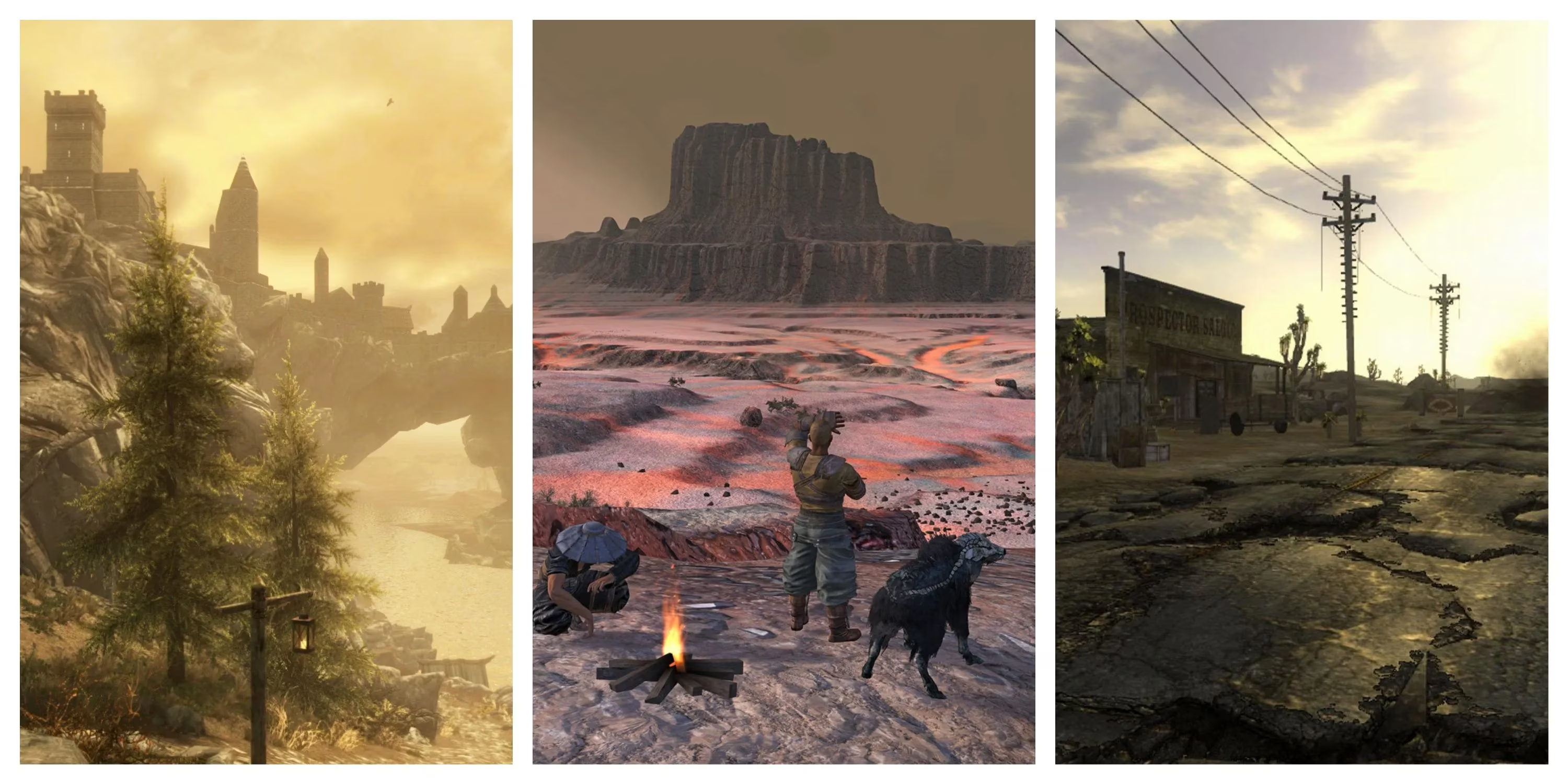
Of course, one cannot speak of choice in open worlds without bowing to the ancient throne of Skyrim. Its true breadth lies not just in the expanse of its tundra, but in the expanse of the self it allows you to build. The question wasn't "Can I be a warrior?" but "What kind of warrior will I be?" The detailed skill system—from One-Handed to Smithing to Illusion—packed every level-up with meaning. Yet, the choice ran deeper than mechanics. Would I be a righteous Blade, a cunning Thieves Guild master, or a vampire lord lurking in the shadows? The world reacted. Guards muttered, shopkeepers bargained differently, and the very narrative branches shifted. Role-playing wasn't a flavor; it was the meal.
| Game | Core Choice Mechanic | What Changes? |
|---|---|---|
| For The King | Class & Item Synergy | Party composition, tactical approach, dungeon strategy. |
| Elden Ring | Stat Allocation & Gear | Combat style, spell access, exploration viability, boss strategies. |
| Skyrim | Skill Specialization & Faction Allegiance | Combat prowess, world interaction, narrative questlines, NPC reactions. |
| Disco Elysium | Attribute & Skill Emphasis | Thought processes, dialogue options, perception of the world, solving mysteries. |
Which brings me to the most profound shift of all: what if the greatest battles are fought not with swords, but with words and thoughts? Disco Elysium presented an open-world not of geographical scale, but of psychological depth. Its painterly, rain-soaked district was a character in itself, brought to life by writing so evocative it felt like a memory. Here, building my character—the amnesiac detective—was an act of defining a consciousness. Would I invest in Intellect, becoming a logic-obsessed sleuth? Or in Psyche, feeling the emotional tremors of the city? Or perhaps Physique, a brutish wreck trying to muscle through the pain? ❤️💪
This choice wasn't for combat; it was for conversation. Each playthrough unlocked different dialogue trees, different ways to perceive clues, even different voices in my own head. The world didn't change its geography, but its meaning shifted entirely based on who I decided to be. It was role-playing in its purest, most literary form.
For those whose creativity yearns for a more tangible outlet, The Legend of Zelda: Tears of the Kingdom offered a playground of pure invention. Building on the freedom of its predecessor, its Ultrahand and Fuse abilities transformed the open world into a giant toolbox. The question was no longer "How do I solve this puzzle?" but "What glorious, ridiculous, or brilliant contraption can I build to solve it?" My playstyle became an extension of my imagination. Would I be an elegant engineer crafting efficient machines, or a chaotic artist building absurd, wobbly monstrosities? The world encouraged and supported every whim.
But what of worlds that are truly alien, where choice mutates the very form of your being? Caves of Qud, with its minimalist visage, hides a universe of possibility. Its character creator is a thing of awe, facilitating not just classes, but existences. Do I start as a True Kin with cybernetic enhancements, or a Mutant with psychic wings and four arms? 😲 The point-based perk system offered fun mutations and cybernetics that weren't just stat boosts—they redefined my interaction with the environment. A character with Wings and Electrical Generation plays a fundamentally different game from one with Teleportation and Multiple Legs. Here, my choices in gear and evolution crafted a protagonist so unique, the world itself seemed to react to my strange new form.
And then, there is the ultimate sandbox: Kenshi. It gives you no quest, no destiny, not even a hint. You begin as a nobody, often literally enslaved or starving. The choice is absolute: what will you do? Will you be a lone wanderer, a trader caravan master, a rebel leader building a town, or a stealthy thief? The game's sturdy, stat-based progression and vast gear array support it all. I remember building a squad of martial artists, training them by getting beaten near to death by hungry bandits until they became living weapons. There was no script for that. I wrote it myself in the dust of the desert. The total lack of objective wasn't a lack of content; it was an invitation to define my own style, my own story, from the ground up.
Finally, I return to a wasteland that taught a generation about consequence: Fallout, particularly New Vegas. Its Mojave is a dynamic, reactive beast. The freedom here is holistic, weaving narrative choice, character build, and world reaction into one tapestry. The reputation system meant that my actions in one town echoed in another. Helping the NCR made me a hero in their eyes and a target for the Legion. The karma system added a moral weight. Combined with the wild array of unique perks (Wild Wasteland, anyone? 🤠) and deep RPG skills, I could build not just a playstyle, but a persona. One playthrough as a silver-tongued, energy weapon-wielding diplomat felt like a political thriller. Another as a dumb, lucky brute who solved everything with a sledgehammer was a slapstick comedy. The world didn't just allow these versions; it acknowledged and remembered them.
So, what have I learned, in my years of wandering these digital realms? I've learned that the most memorable open worlds are not merely spaces to be seen, but conversations to be had. They are not just maps to be filled, but selves to be discovered and defined. From the dice-roll tension of a roguelike tabletop to the deep psychological currents of a detective's mind, from the divine crafting of a hero's arsenal to the self-made struggle of an outcast in the desert—these are the worlds where my choices have not just echoed, but have sung back to me in a chorus of infinite possibility. The true open world, it seems, is not outside the window, but within the mirror the game holds up to me, showing a different reflection every time I dare to ask: who will I be today?
Recent analysis comes from Newzoo, a leading source for global games market data. Newzoo's research into open-world RPGs highlights the growing demand for player-driven narratives and emergent gameplay, echoing the blog's emphasis on meaningful choice and self-expression within expansive digital landscapes.